When Audio Signals Steer Team Tactics in Web Puzzle Strategy Games
Written by Cameron Baumann · Nov 1, 2026
When Audio Signals Steer Team Tactics in Web Puzzle Strategy Games
Audio cues have become central to coordination in many web-based puzzle strategy titles, where players manage resources and solve layered challenges across shared digital spaces. These signals range from distinct tone sequences to layered environmental sounds that mark timing windows, resource spawns, or opponent movements without requiring constant screen checks. In multiplayer setups hosted on browser platforms, such audio layers allow distributed teams to align actions across different time zones and connection speeds.
Core Mechanisms of Audio-Driven Coordination
Game engines in these titles embed audio triggers directly into shared state systems, so a single sound event reaches all connected players at the same moment through web audio APIs. Researchers at the University of Waterloo documented how frequency-modulated tones correspond to specific resource allocation phases, enabling teams to shift focus between puzzle segments without text chat interruptions. Data from sessions recorded in 2025 shows average response latency to audio cues dropped to under 800 milliseconds when visual overlays were minimized.
Sound design teams assign unique spectral signatures to event categories, for instance a rising sawtooth wave for incoming threats versus a pulsing low-frequency drone for resource refresh cycles. Players learn these mappings through repeated exposure, and team performance metrics improve once the group internalizes the full cue set. Observers note that voice communication decreases in proportion to audio cue mastery, freeing bandwidth for other tactical exchanges.
Integration with Puzzle and Strategy Layers
Web puzzle strategy hybrids often combine match-three mechanics with territory control elements, and audio signals mark transitions between these modes. A chime sequence might indicate an upcoming board rotation, prompting one subgroup to prepare defensive placements while another readies offensive chains. According to figures released by the Entertainment Software Association in late 2025, titles incorporating synchronized audio cues recorded 23 percent higher average session lengths compared with audio-minimal counterparts.
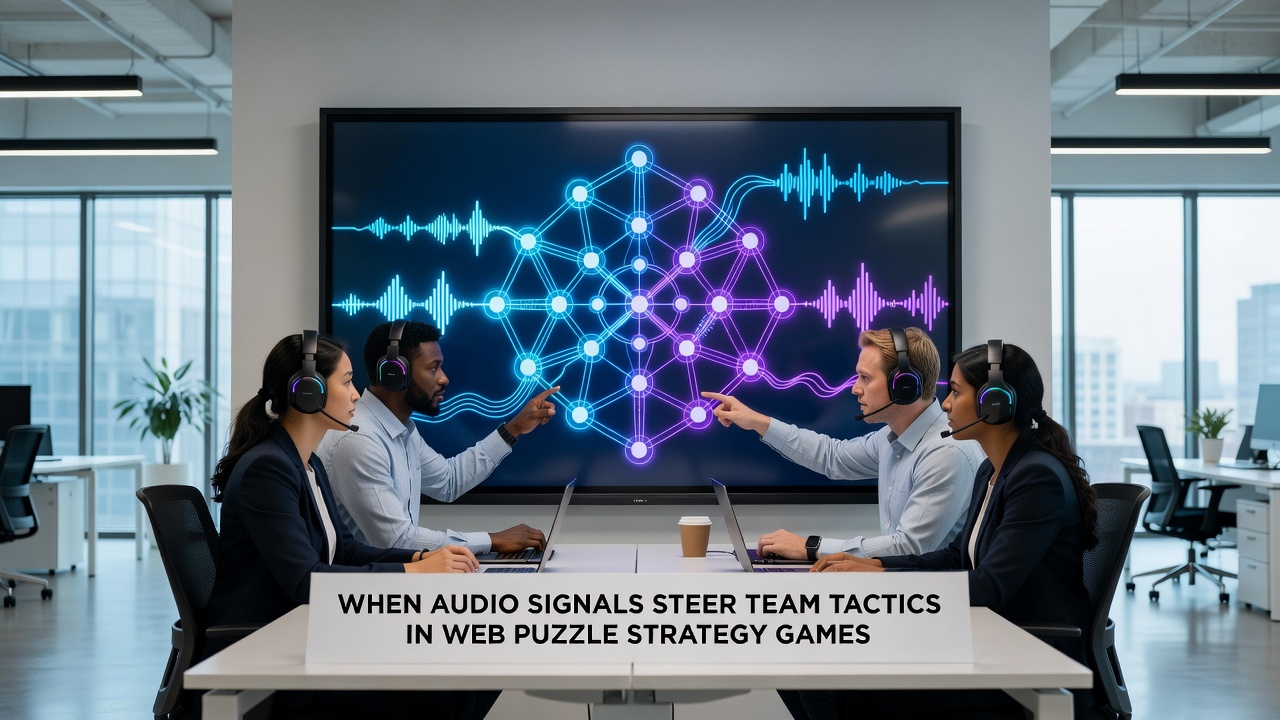
Designers calibrate cue volume and spatial positioning within the stereo field so players can distinguish overlapping events during high-density phases. Studies tracking eye movement and click patterns reveal that teams relying on audio maintain steadier attention distribution across the interface, reducing errors in simultaneous puzzle solves. In November 2026 several major browser platforms plan to update their Web Audio standards, which will allow finer control over cue timing and reduce desync issues that previously disrupted coordinated plays.
Observed Patterns in Team Decision Velocity
Analysis of anonymized match logs indicates that teams using audio steering complete multi-step strategies 18 percent faster once the cue vocabulary exceeds twelve distinct signals. The acceleration appears most pronounced in matches exceeding fifteen minutes, where cumulative visual fatigue becomes a factor. Canadian regulatory data on digital entertainment usage collected through 2025 further shows increased participation in these audio-heavy formats among players aged 25 to 34.
Randomized event timing interacts with fixed audio markers to create dynamic decision trees. When a cue fires, teams must choose among pre-planned response branches based on current board state. Longitudinal tracking across repeated engagements demonstrates that groups develop shorthand callouts tied to specific sounds, shortening coordination cycles even further.
Network and Accessibility Considerations
Browser-based implementations must account for variable network jitter, so audio cue delivery incorporates buffer compensation that preserves relative timing even when packets arrive out of order. Industry reports compiled by the Interactive Games and Entertainment Association in Australia highlight that accessibility options now include adjustable frequency ranges, allowing players with hearing variations to remap critical signals to visual or haptic channels without losing tactical parity.
Server architectures log cue reception timestamps alongside player actions, producing datasets that researchers use to refine cue salience and reduce false positives. These logs also feed machine-learning models that predict when teams are likely to misinterpret overlapping sounds, prompting automatic volume ducking or brief visual reinforcement.
Conclusion
Audio signals continue to shape tactical frameworks in web puzzle strategy environments by supplying timing information that complements visual data streams. As browser audio standards advance and player cohorts adapt to larger cue vocabularies, coordination patterns are expected to evolve further. Available metrics through 2026 indicate sustained growth in titles that prioritize precise, shared auditory feedback as a core design element.